The sit and reach test measures the flexibility of the lower back muscles as well and the hamstrings. The test however requires the use of a sit and reach box, but can also be done with a ruler. The test starts with the subject sitting down with there feet against the measuring block. The subject then reaches forward as far as they can, with there hands out stretched in front of them. On the blocks have measurements on them, the feet mark zero. The measurement is then read from where the tops of the fingers reach on the block. A score below zero (the feet) give a minus score and any thing above is a positive.
The test has some clear benefits, one of which is that it can be done without the use of specialist equipment, and can be done basically with a ruler. The test can also doesn't require alot of time, and can be done to quickly test flexibility.
However there are also some disadvantages, one of which is that every ones body is slightly different. This means, for example, that if a person has shorter legs and longer arms it means that there score is likely to be higher than someone who has long legs and short arms. Also, the it only measures the flexibility of certain areas of the body, names the lower back and hamstring. Both of these can lead to misleading results.
Strength
A good test for strength is called the 'grip dynamometer test'. This particular test requires the sole use of a piece of specialist equipment, the grip dynamometer. The test is done by taking the dynamometer and putting it in the dominant hand of the subject. The subject then squeezes as hard as they can and the highest amount achieved is stored on the device, or if it is an analogue meter a needle will stop on the highest reading. The test is then repeated three times to ensure accuracy.
The test again has its benefits, one clear advantage is that the test can be done anywhere as it only requires the use of a small piece of equipment and doesn't require the use of a specialist area e.g a gym. Another is that it is extremely simple to do, as no trained assistance is needed and can be carried out by anyone.
A disadvantage of this test tho is that it does require the use of the grip dynamometer equipment, and cannot be done without this piece of equipment. Also, the test only really measures the strength of particular muscles sets of the subject, namely the forearm and hand. This means that it doesn't represent the entire body strength of the user. This would have to be done with a number of test as well as this one.
Aerobic Endurance
To test for aerobic endurance a number of test can be carried out, one of these tests is called the bleep test. This test requires the use of a flat space 20m wide, marking cones and a bleep CD. The test is carried out by the subject told to start running between the recording with the sound of a bleep, the subject then has to run to the cones on the opposite side before the second bleep. This then continues, but each time the time between the bleeps decreases meaning the subject has to run faster, this is when the level of the test is increasing. The test continues until the subject doesn't make it to the other side of cone when the bleep sounds. The test is marked by what the last level the subject completed.
One advantage of this test is that it can be done by a large group of subjects at the same time, meaning a large number can be tested at once. The test also requires the maximum effort of the subject, unlike some other tests for aerobic endurance.
Some disadvantages of this test is that it requires a reasonably large amount of flat ground to be carried out on, meaning that it cannot be carried out in alot of places. Also it requires the use of the bleep CD, however this is easily obtainable. Also the test requires full motivation of the subject, as if they don't want to score highly they may decide to not put maximum effort in.
Muscular Endurance
A test for muscular endurance is the pull up test. This test requires a pull up bar. The subject grasps the bar with an over hand grip. The subject then has to complete a as many full pull ups as they can. A full pull up requires the user to pull from a hanging position, pull all the way to when their chin is above the bar and then lower down back to the original hanging position. These actions should be smooth, and kicking or wiggly pull ups are not counted.
This test is requires the use of simple equipment which is easily and readily available, as it can be done from any horizontal suspended bar, which is a clear advantage of this test over other muscular endurance tests. Also, the test is very easy and simple to carry out and no specialist recording equipment is required.
The test also has some disadvantages however, one of these is that the technique that subjects used may be very varied, which makes it hard to standardise scoring and make it a fair test for everyone. This means for some groups of users it may be better to perform another muscular endurance test such as the flexed arm hanging test. Also, the body weight of the subject greatly effects how many pull ups they can achieve.
Body composition
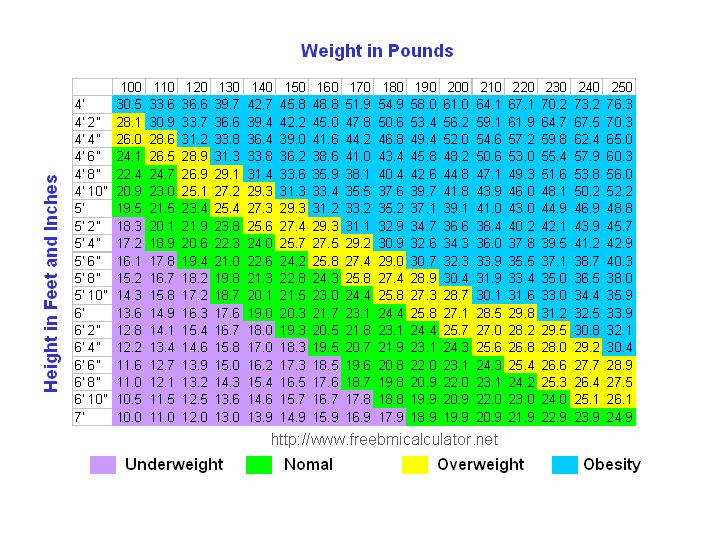
There are a number of tests that can be conducted in regards to body composition. One of these tests is a calculation called body mass index. In order to calculate body mass index you must first know the subjects height in meters and weight in kilogrammes. The calculation is for BMI is calculated by (M) / (H x H). H= Height, W= Weight.
The test gives a quick and easy representation of someones height through a simple calculation, where as other test for body composition require specialist equipment. This is a clear advantage of using BMI calculations to test for body composition.
However, the BMI calculation has some flaws. One of these is that it can be very inaccurate because it doesn't take into account muscle weight, so if someone is has a lot of muscle mass they may be wrongly classes as obese, especially if the subject is particularly short.
Here is the table for BMI mesurements: